
Practice Modern History MCQ Free 100 Set 1 with answers and detailed explanations. Perfect for SSC, UPSC, MPSC and all competitive exams preparation.
Ancient History is a very important part of any competitive exam (SSC, UPSC, MPSC, NET/SET). Many students initially find this subject boring, but if you solve the MCQs the right way, it becomes very easy and high-scoring.
Imagine – a student from a small village practised only 20 MCQs daily, and within a few months, he cleared the MPSC exam. What is his secret? Daily Practice + Concept + MCQs.
In this article, we will see 100 MCQs for various competitive exams (SSC, UPSC, MPSC, NET/SET) based on ancient history mcqs.
Ancient History MCQs for SSC
Ancient History is one of the most scoring sections in SSC exams because questions are direct, factual, and concept-based. If you focus on timelines, important personalities, and key facts, you can easily boost your score. Below are 20 carefully selected Ancient History MCQs for SSC with 4 options, correct answers, and detailed explanations.
Q1. Which was the largest city of the Indus Valley Civilisation?
A) Harappa
B) Mohenjo-daro
C) Lothal
D) Kalibangan
✔️ Answer: B) Mohenjo-daro
👉 Explanation: Mohenjo-daro was the largest and most advanced city, known for its excellent drainage and urban planning.
Q2. What is the approximate period of the Vedic Age?
A) 1500–600 BCE
B) 2000–1000 BCE
C) 1000–500 BCE
D) 3000 BCE
✔️ Answer: A) 1500–600 BCE
👉 Explanation: The Vedic period started around 1500 BCE with the composition of the Rigveda.
Q3. The Indus Valley Civilisation developed along which river?
A) Ganga
B) Yamuna
C) Indus
D) Saraswati
✔️ Answer: C) Indus
👉 Explanation: The civilisation flourished along the Indus River, hence its name.
Q4. Which is the oldest Veda?
A) Samaveda
B) Yajurveda
C) Atharvaveda
D) Rigveda
✔️ Answer: D) Rigveda
👉 Explanation: The Rigveda is the oldest sacred text and contains hymns dedicated to various gods.
Q5. Where was Gautama Buddha born?
A) Bodh Gaya
B) Sarnath
C) Lumbini
D) Kushinagar
✔️ Answer: C) Lumbini
👉 Explanation: Buddha was born in Lumbini, which is in present-day Nepal.
Q6. Who was the 24th Tirthankara of Jainism?
A) Rishabhadeva
B) Parshvanatha
C) Mahavira
D) Neminatha
✔️ Answer: C) Mahavira
👉 Explanation: Mahavira was the last and most important Tirthankara of Jainism.
Q7. Who founded the Mauryan Empire?
A) Ashoka
B) Chandragupta Maurya
C) Bindusara
D) Harsha
✔️ Answer: B) Chandragupta Maurya
👉 Explanation: Chandragupta Maurya established the Mauryan Empire in 322 BCE.
Q8. Which religion was adopted by Emperor Ashoka after the Kalinga War?
A) Hinduism
B) Jainism
C) Buddhism
D) Sikhism
✔️ Answer: C) Buddhism
👉 Explanation: After witnessing the destruction of the Kalinga War, Ashoka embraced Buddhism.
Q9. Nalanda University was located in which state?
A) Uttar Pradesh
B) Bihar
C) Madhya Pradesh
D) Odisha
✔️ Answer: B) Bihar
👉 Explanation: Nalanda was a famous ancient centre of learning in Bihar.
Q10. Which was the port city of the Indus Valley Civilisation?
A) Harappa
B) Mohenjo-daro
C) Lothal
D) Dholavira
✔️ Answer: C) Lothal
👉 Explanation: Lothal had a dockyard and was an important trade centre.
Q11. What was the main occupation of the Aryans?
A) Trade
B) Agriculture
C) Hunting
D) Fishing
✔️ Answer: B) Agriculture
👉 Explanation: Aryans were primarily agricultural people, though they also practised cattle rearing.
Q12. What is the main subject of the Upanishads?
A) Warfare
B) Rituals
C) Philosophy
D) Politics
✔️ Answer: C) Philosophy
👉 Explanation: Upanishads deal with philosophical ideas like the soul (Atman) and Brahman.
Q13. Where did Buddha deliver his first sermon?
A) Lumbini
B) Sarnath
C) Bodh Gaya
D) Rajgir
✔️ Answer: B) Sarnath
👉 Explanation: Buddha gave his first sermon at Sarnath, known as “Dharmachakra Pravartana”.
Q14. Who is considered the founder of Jainism?
A) Mahavira
B) Parshvanatha
C) Rishabhadeva
D) Gautama Buddha
✔️ Answer: C) Rishabhadeva
👉 Explanation: Rishabhadeva is regarded as the first Tirthankara and founder of Jainism.
Q15. Why is the Gupta period known as the Golden Age?
A) Military expansion
B) Religious dominance
C) Economic decline
D) Advancement in arts and science
✔️ Answer: D) Advancement in arts and science
👉 Explanation: The Gupta period saw great progress in literature, science, and art.
Q16. Which god was most important during the Rigvedic period?
A) Vishnu
B) Shiva
C) Indra
D) Brahma
✔️ Answer: C) Indra
👉 Explanation: Indra was the chief deity and god of rain and thunder.
Q17. What is the main focus of Brahmana texts?
A) Philosophy
B) Rituals and sacrifices
C) Warfare
D) Politics
✔️ Answer: B) Rituals and sacrifices
👉 Explanation: Brahmana texts explain the procedures of Vedic rituals and sacrifices.
Q18. How many Vedas are there?
A) 2
B) 3
C) 4
D) 5
✔️ Answer: C) 4
👉 Explanation: The four Vedas are Rigveda, Samaveda, Yajurveda, and Atharvaveda.
Q19. When did the Kalinga War take place?
A) 300 BCE
B) 261 BCE
C) 150 BCE
D) 100 BCE
✔️ Answer: B) 261 BCE
👉 Explanation: The Kalinga War was fought in 261 BCE during Ashoka’s reign.
Q20. Who wrote the book “Arthashastra”?
A) Ashoka
B) Kalidasa
C) Chanakya (Kautilya)
D) Panini
✔️ Answer: C) Chanakya (Kautilya)
👉 Explanation: Arthashastra is a treatise on statecraft, economics, and administration written by Chanakya.
Ancient History MCQs for UPSC
UPSC preparation demands more than just memorising facts—it requires conceptual clarity, analytical thinking, and understanding the “why” behind events. Ancient History questions in UPSC often test your ability to connect ideas like society, economy, religion, and governance.
Below are 20 high-quality Ancient History MCQs for UPSC with 4 options, correct answers, and detailed explanations.
Q1. How was the drainage system of the Indus Valley Civilisation?
A) Primitive and unplanned
B) Moderately developed
C) Highly advanced and systematic
D) Non-existent
✔️ Answer: C) Highly advanced and systematic
👉 Explanation: The Indus cities had covered drains, proper sewage disposal, and grid planning, indicating advanced urban management.
Q2. What were ‘Sabha’ and ‘Samiti’ in Vedic society?
A) Religious institutions
B) Political assemblies
C) Military groups
D) Trade unions
✔️ Answer: B) Political assemblies
👉 Explanation: Sabha and Samiti were early democratic institutions that played a role in governance and decision-making.
Q3. Which path was advocated by Gautama Buddha?
A) Extreme asceticism
B) Middle Path
C) Ritualism
D) Materialism
✔️ Answer: B) Middle Path
👉 Explanation: Buddha rejected both luxury and extreme austerity, advocating a balanced approach to life.
Q4. How is the concept of Ahimsa in Jainism best described?
A) Moderate
B) Symbolic
C) Strict and absolute
D) Limited to humans
✔️ Answer: C) Strict and absolute
👉 Explanation: Jainism emphasises complete non-violence toward all living beings, even microorganisms.
Q5. What was a key feature of the Mauryan administration?
A) Decentralised governance
B) Tribal leadership
C) Centralised administration
D) Religious rule
✔️ Answer: C) Centralised administration
👉 Explanation: The Mauryan Empire had a strong central authority with the king as the supreme ruler.
Q6. In which language were Ashokan inscriptions primarily written?
A) Sanskrit
B) Prakrit
C) Tamil
D) Pali
✔️ Answer: B) Prakrit
👉 Explanation: Most inscriptions were in Prakrit using the Brahmi script to reach the common people.
Q7. Who was a prominent scientist during the Gupta period?
A) Varahamihira
B) Aryabhata
C) Charaka
D) Sushruta
✔️ Answer: B) Aryabhata
👉 Explanation: Aryabhata made significant contributions to mathematics and astronomy during the Gupta age.
Q8. What is the main subject of the Arthashastra?
A) Religion
B) Warfare
C) Statecraft and governance
D) Philosophy
✔️ Answer: C) Statecraft and governance
👉 Explanation: Written by Chanakya, the Arthashastra deals with administration, economy, and political strategies.
Q9. Who played a major role in spreading Buddhism?
A) Chandragupta Maurya
B) Ashoka
C) Harsha
D) Kanishka
✔️ Answer: B) Ashoka
👉 Explanation: After the Kalinga War, Ashoka promoted Buddhism across India and abroad.
Q10. What was the main economic activity in early Vedic society?
A) Trade
B) Agriculture
C) Pastoralism
D) Industry
✔️ Answer: C) Pastoralism
👉 Explanation: Early Vedic society was primarily pastoral, with cattle wealth being important.
Q11. What do the Upanishads mainly teach?
A) Rituals
B) Warfare
C) Spiritual knowledge of Atman and Brahman
D) Trade practices
✔️ Answer: C) Spiritual knowledge of Atman and Brahman
👉 Explanation: Upanishads focus on philosophical ideas about soul and ultimate reality.
Q12. What is ‘Sangha’ in Buddhism?
A) A temple
B) A religious text
C) A monastic community
D) A ritual
✔️ Answer: C) A monastic community
👉 Explanation: Sangha refers to the community of Buddhist monks and followers.
Q13. What was the main purpose of a Stupa?
A) Residence
B) Temple
C) Burial monument
D) Administrative centre
✔️ Answer: C) Burial monument
👉 Explanation: Stupas were built to preserve relics of Buddha and serve as places of worship.
Q14. What does ‘Dhamma’ as propagated by Ashoka signify?
A) Law
B) Religion
C) Moral code of conduct
D) Military policy
✔️ Answer: C) Moral code of conduct
👉 Explanation: Ashoka’s Dhamma emphasised ethics, compassion, and non-violence.
Q15. How is Gupta period art generally described?
A) Primitive
B) Declining
C) Highly refined
D) Foreign-influenced
✔️ Answer: C) Highly refined
👉 Explanation: Gupta art is considered classical and reached great heights in sculpture and painting.
Q16. Iron was first widely used in which period?
A) Harappan
B) Early Vedic
C) Later Vedic
D) Mauryan
✔️ Answer: C) Later Vedic
👉 Explanation: Iron tools helped expand agriculture and settlements during the Later Vedic period.
Q17. Urban development is a key feature of which civilisation?
A) Vedic
B) Harappan
C) Gupta
D) Mauryan
✔️ Answer: B) Harappan
👉 Explanation: Planned cities with roads, drainage, and buildings mark the Harappan civilisation.
Q18. Where did Gautama Buddha attain Mahaparinirvana?
A) Lumbini
B) Bodh Gaya
C) Sarnath
D) Kushinagar
✔️ Answer: D) Kushinagar
👉 Explanation: Buddha passed away at Kushinagar, marking his final liberation.
Q19. Vedic gods were mainly associated with:
A) Politics
B) Nature
C) Trade
D) Warfare only
✔️ Answer: B) Nature
👉 Explanation: Gods like Indra (rain), Agni (fire), and Varuna (water) were natural forces.
Q20. During which period did the Sanskrit language flourish?
A) Harappan
B) Mauryan
C) Gupta
D) Vedic
✔️ Answer: C) Gupta
👉 Explanation: Sanskrit literature, including works of Kalidasa, flourished during the Gupta age.
Ancient History MCQs for MPSC
MPSC exams focus on a strong combination of Ancient Indian History and Maharashtra-specific history. Questions are often factual but require clarity about regional dynasties like Satavahanas, trade routes, culture, and art.
Below are 20 important Ancient History MCQs for MPSC with 4 options, correct answers, and detailed explanations.
Q1. Which dynasty was prominent in ancient Maharashtra?
A) Maurya
B) Gupta
C) Satavahana
D) Chola
✔️ Answer: C) Satavahana
👉 Explanation: The Satavahana dynasty was one of the earliest rulers of the Deccan region, including Maharashtra.
Q2. What was the capital of the Satavahanas?
A) Ujjain
B) Paithan (Pratishthana)
C) Pataliputra
D) Amaravati
✔️ Answer: B) Paithan (Pratishthana)
👉 Explanation: Paithan in Maharashtra served as the main capital of the Satavahanas.
Q3. Which language was mainly used during the Satavahana period?
A) Sanskrit
B) Prakrit
C) Tamil
D) Pali
✔️ Answer: B) Prakrit
👉 Explanation: Most inscriptions and literature of the Satavahana period were in Prakrit.
Q4. What was the major trade route during ancient Maharashtra?
A) Land routes only
B) River routes
C) Sea routes
D) Air routes
✔️ Answer: C) Sea routes
👉 Explanation: Satavahanas developed maritime trade, especially with the Roman Empire.
Q5. How was coin usage during the Satavahana period?
A) Very limited
B) Not used
C) Widely used
D) Only gold coins
✔️ Answer: C) Widely used
👉 Explanation: Satavahanas issued coins made of lead, copper, and silver for trade.
Q6. Which art form is associated with ancient Maharashtra?
A) Khajuraho temples
B) Ajanta paintings
C) Meenakshi temple
D) Sun temple
✔️ Answer: B) Ajanta paintings
👉 Explanation: Ajanta caves in Maharashtra are famous for their Buddhist paintings.
Q7. Which religion had a major influence during the Satavahana period?
A) Jainism
B) Buddhism
C) Sikhism
D) Christianity
✔️ Answer: B) Buddhism
👉 Explanation: Satavahanas supported Buddhism, leading to the construction of caves and stupas.
Q8. Which cave architecture is found in Maharashtra?
A) Ajanta
B) Ellora
C) Karle
D) All of the above
✔️ Answer: D) All of the above
👉 Explanation: Maharashtra is rich in rock-cut architecture, including Ajanta, Ellora, and Karle caves.
Q9. Which was an ancient port in Maharashtra?
A) Surat
B) Sopara
C) Kochi
D) Goa
✔️ Answer: B) Sopara
👉 Explanation: Sopara was an important ancient port facilitating trade.
Q10. In which script were most ancient inscriptions written?
A) Devanagari
B) Brahmi
C) Persian
D) Arabic
✔️ Answer: B) Brahmi
👉 Explanation: Brahmi was the earliest script used in ancient India for inscriptions.
Q11. Who was a famous Satavahana ruler?
A) Ashoka
B) Gautamiputra Satakarni
C) Harsha
D) Samudragupta
✔️ Answer: B) Gautamiputra Satakarni
👉 Explanation: He was one of the greatest Satavahana rulers who defeated the Shakas.
Q12. Which religion was widely practised during this period?
A) Hinduism
B) Buddhism
C) Islam
D) Sikhism
✔️ Answer: B) Buddhism
👉 Explanation: Buddhist influence was strong in trade and art centres.
Q13. Trade relations of Satavahanas were mainly with which civilisation?
A) Chinese
B) Greek
C) Roman
D) Persian
✔️ Answer: C) Roman
👉 Explanation: Roman coins found in India indicate strong trade relations.
Q14. How was the tax system in ancient Maharashtra?
A) Weak
B) Non-existent
C) Developed
D) Unorganised
✔️ Answer: C) Developed
👉 Explanation: The Satavahana administration had a structured tax system.
Q15. Which type of art was prominent?
A) Painting only
B) Sculpture
C) Music
D) Dance
✔️ Answer: B) Sculpture
👉 Explanation: Rock-cut sculptures and cave carvings were highly developed.
Q16. Which language dominated literature during the Satavahana rule?
A) Sanskrit
B) Prakrit
C) Tamil
D) Urdu
✔️ Answer: B) Prakrit
👉 Explanation: Prakrit was widely used for inscriptions and literary works.
Q17. What type of social system existed?
A) Tribal
B) Classless
C) Varna system
D) Feudal
✔️ Answer: C) Varna system
👉 Explanation: Society was divided into different varnas (classes).
Q18. What was the main economic activity?
A) Industry
B) Agriculture
C) Mining
D) Fishing
✔️ Answer: B) Agriculture
👉 Explanation: Agriculture formed the backbone of the economy.
Q19. How were ports in ancient Maharashtra?
A) Declining
B) Underdeveloped
C) Flourishing
D) Closed
✔️ Answer: C) Flourishing
👉 Explanation: Ports like Sopara boosted trade and economic growth.
Q20. How can the culture of this period be described?
A) Purely Vedic
B) Foreign
C) Mixed and diverse
D) Tribal
✔️ Answer: C) Mixed and diverse
👉 Explanation: Culture included influences of Vedic traditions, Buddhism, and foreign trade contacts.
Ancient History MCQs for Competitive Exam
In competitive exams like SSC, UPSC, MPSC, Railways, and other government exams, Ancient History questions are often mixed and concept-based. Practising such mixed MCQs improves both speed and accuracy, helping you tackle unpredictable questions in exams.
Below are 20 important Ancient History MCQs for Competitive Exams with 4 options, correct answers, and clear explanations.
Q1. Which is the earliest civilisation of India?
A) Vedic Civilisation
B) Gupta Civilisation
C) Indus Valley Civilization
D) Mauryan Civilization
✔️ Answer: C) Indus Valley Civilisation
👉 Explanation: The Indus Valley Civilisation (c. 2500 BCE) is the earliest known urban civilisation in India.
Q2. What is the symbol associated with Buddhism?
A) Lotus
B) Wheel (Chakra)
C) Trident
D) Conch
✔️ Answer: B) Wheel (Chakra)
👉 Explanation: The Dharma Chakra represents the teachings of Buddha and the cycle of life.
Q3. What is the symbol of Jainism?
A) Wheel
B) Hand with wheel
C) Lotus
D) Tree
✔️ Answer: B) Hand with wheel
👉 Explanation: The raised hand with a wheel symbolises non-violence (Ahimsa) in Jainism.
Q4. What is the emblem of the Mauryan Empire?
A) Elephant
B) Horse
C) Lion
D) Bull
✔️ Answer: C) Lion
👉 Explanation: The Lion Capital of Ashoka is the symbol of the Mauryan Empire and modern India.
Q5. What was the nature of Vedic society?
A) Urban
B) Industrial
C) Rural
D) Nomadic only
✔️ Answer: C) Rural
👉 Explanation: Vedic society was primarily rural and based on agriculture and cattle rearing.
Q6. How is Gupta art generally described?
A) Primitive
B) Golden and classical
C) Declining
D) Foreign influence
✔️ Answer: B) Golden and classical
👉 Explanation: The Gupta period is known as the Golden Age due to excellence in art and culture.
Q7. What was Lothal known for?
A) Temple
B) Capital city
C) Port
D) Fort
✔️ Answer: C) Port
👉 Explanation: Lothal was an important dockyard and trade centre of the Indus Valley Civilisation.
Q8. What is a Stupa?
A) Palace
B) Temple
C) Burial monument
D) School
✔️ Answer: C) Burial monument
👉 Explanation: Stupas were built to preserve relics of Buddha.
Q9. Which religion was founded by Gautama Buddha?
A) Hinduism
B) Jainism
C) Buddhism
D) Sikhism
✔️ Answer: C) Buddhism
👉 Explanation: Buddhism was founded by Gautama Buddha in the 6th century BCE.
Q10. Who was a famous Mauryan ruler?
A) Harsha
B) Ashoka
C) Samudragupta
D) Kanishka
✔️ Answer: B) Ashoka
👉 Explanation: Ashoka was one of the greatest rulers known for spreading Buddhism.
Q11. Which language flourished during the Gupta period?
A) Tamil
B) Prakrit
C) Sanskrit
D) Persian
✔️ Answer: C) Sanskrit
👉 Explanation: Sanskrit literature reached its peak during the Gupta period.
Q12. What type of social system existed in ancient India?
A) Classless
B) Tribal
C) Varna system
D) Feudal
✔️ Answer: C) Varna system
👉 Explanation: Society was divided into four varnas: Brahmin, Kshatriya, Vaishya, and Shudra.
Q13. What was the main economic activity in ancient India?
A) Trade
B) Industry
C) Agriculture
D) Fishing
✔️ Answer: C) Agriculture
👉 Explanation: Agriculture was the backbone of the ancient Indian economy.
Q14. What type of trade was common in ancient India?
A) Air trade
B) Digital trade
C) Sea trade
D) No trade
✔️ Answer: C) Sea trade
👉 Explanation: Ancient India had strong maritime trade links with other civilisations.
Q15. Which type of art was prominent in ancient India?
A) Music
B) Dance
C) Sculpture
D) Drama
✔️ Answer: C) Sculpture
👉 Explanation: Sculpture and rock-cut architecture were highly developed.
Q16. Which was a famous ancient university?
A) Takshashila
B) Nalanda
C) Vikramshila
D) All of the above
✔️ Answer: D) All of the above
👉 Explanation: All three were important centres of learning in ancient India.
Q17. Which are the oldest religious texts in India?
A) Upanishads
B) Puranas
C) Vedas
D) Ramayana
✔️ Answer: C) Vedas
👉 Explanation: The Vedas are the oldest sacred texts of India.
Q18. Which religion was founded by Mahavira?
A) Buddhism
B) Jainism
C) Sikhism
D) Hinduism
✔️ Answer: B) Jainism
👉 Explanation: Mahavira was the 24th Tirthankara and a key figure in Jainism.
Q19. Who was the founder of the Mauryan Empire?
A) Ashoka
B) Chandragupta Maurya
C) Bindusara
D) Harsha
✔️ Answer: B) Chandragupta Maurya
👉 Explanation: He established the Mauryan Empire with the help of Chanakya.
Q20. How can ancient Indian culture be described?
A) Uniform
B) Isolated
C) Diverse and rich
D) Primitive
✔️ Answer: C) Diverse and rich
👉 Explanation: Ancient India had a mix of cultures, religions, and traditions.
Ancient History MCQs for NET/SET Exam
NET/SET exams demand deep conceptual understanding and analytical thinking rather than simple factual recall. Questions often test your clarity on philosophy, society, religion, and administration in ancient India.
Below are 20 high-quality Ancient History MCQs for NET/SET with 4 options, correct answers, and detailed explanations.
Q1. What was the status of women in early Vedic society?
A) Very poor
B) No rights
C) Relatively high and respected
D) Restricted to domestic work only
✔️ Answer: C) Relatively high and respected
👉 Explanation: Women in early Vedic society had access to education, participated in religious rituals, and enjoyed a respectable position.
Q2. What is the central theme of the Upanishads?
A) Rituals
B) Warfare
C) Spiritual knowledge (Atman and Brahman)
D) Trade
✔️ Answer: C) Spiritual knowledge (Atman and Brahman)
👉 Explanation: The Upanishads focus on philosophical discussions about the soul (Atman) and ultimate reality (Brahman).
Q3. What is the ultimate goal of Buddhism?
A) Wealth accumulation
B) Salvation through rituals
C) Liberation from suffering (Nirvana)
D) Political power
✔️ Answer: C) Liberation from suffering (Nirvana)
👉 Explanation: Buddhism aims to end suffering through the Eightfold Path, achieving Nirvana.
Q4. What is the core principle of Jainism?
A) Ritualism
B) Ahimsa (Non-violence)
C) Materialism
D) Devotion
✔️ Answer: B) Ahimsa (Non-violence)
👉 Explanation: Jainism emphasises strict non-violence toward all living beings.
Q5. How is scientific development during the Gupta period described?
A) Declining
B) Static
C) Progressive and advanced
D) Non-existent
✔️ Answer: C) Progressive and advanced
👉 Explanation: Scholars like Aryabhata contributed to mathematics and astronomy, making it a golden age of science.
Q6. Who authored the Arthashastra?
A) Ashoka
B) Kalidasa
C) Kautilya (Chanakya)
D) Panini
✔️ Answer: C) Kautilya (Chanakya)
👉 Explanation: Arthashastra is a detailed treatise on governance, economy, and administration.
Q7. What does Ashoka’s ‘Dhamma’ emphasise?
A) Military expansion
B) Religious conversion
C) Moral and ethical conduct
D) Trade development
✔️ Answer: C) Moral and ethical conduct
👉 Explanation: Ashoka promoted values like non-violence, compassion, and tolerance.
Q8. What is the structural shape of a Stupa?
A) Square
B) Rectangular
C) Circular/dome-shaped
D) Pyramid
✔️ Answer: C) Circular/dome-shaped
👉 Explanation: Stupas are hemispherical structures built to house relics of Buddha.
Q9. How many Vedas are there?
A) 2
B) 3
C) 4
D) 5
✔️ Answer: C) 4
👉 Explanation: The four Vedas are Rigveda, Samaveda, Yajurveda, and Atharvaveda.
Q10. What type of social structure existed in ancient India?
A) Classless
B) Tribal
C) Varna system
D) Socialist
✔️ Answer: C) Varna system
👉 Explanation: Society was divided into four varnas based on occupation and duties.
Q11. How can ancient Indian religion be described?
A) Monolithic
B) Rigid
C) Diverse and pluralistic
D) Non-religious
✔️ Answer: C) Diverse and pluralistic
👉 Explanation: Multiple religious traditions like Vedic, Buddhist, and Jain coexisted.
Q12. What was the primary mode of education in ancient India?
A) Online
B) Gurukul system
C) Institutional colleges
D) Military training
✔️ Answer: B) Gurukul system
👉 Explanation: Students lived with teachers (gurus) and received holistic education.
Q13. What was the main basis of the ancient Indian economy?
A) Industry
B) Agriculture
C) Trade only
D) Mining
✔️ Answer: B) Agriculture
👉 Explanation: Agriculture formed the backbone of economic life.
Q14. What type of trade was dominant in early periods?
A) International only
B) Internal/domestic trade
C) Air trade
D) No trade
✔️ Answer: B) Internal/domestic trade
👉 Explanation: Local trade networks were dominant, later expanding to international trade.
Q15. How is ancient Indian culture best described?
A) Uniform
B) Isolated
C) Diverse and evolving
D) Primitive
✔️ Answer: C) Diverse and evolving
👉 Explanation: Cultural practices evolved with influences from different regions and religions.
Q16. What type of governance was prevalent in empires like the Maurya?
A) Federal
B) Decentralised
C) Centralised monarchy
D) Democracy
✔️ Answer: C) Centralised monarchy
👉 Explanation: The king held supreme authority with a structured प्रशासन system.
Q17. How was art during ancient India?
A) Declining
B) Primitive
C) Advanced and expressive
D) Non-existent
✔️ Answer: C) Advanced and expressive
👉 Explanation: Art flourished in forms like sculpture, paintings, and architecture.
Q18. What was the level of scientific knowledge in ancient India?
A) Poor
B) Moderate
C) Highly developed
D) Absent
✔️ Answer: C) Highly developed
👉 Explanation: Advances were made in mathematics, astronomy, and medicine.
Q19. How can ancient Indian philosophy be characterised?
A) Simple
B) Superficial
C) Deep and complex
D) Non-existent
✔️ Answer: C) Deep and complex
👉 Explanation: Philosophical schools like Vedanta and Buddhism explored deep existential questions.
Q20. How is ancient Indian history generally viewed?
A) Limited
B) Fragmented
C) Rich and extensive
D) Unimportant
✔️ Answer: C) Rich and extensive
👉 Explanation: Ancient India has a vast and diverse historical legacy.
Conclusion
If you practice ancient history MCQs regularly, you can solve any competitive exam (SSC, UPSC, MPSC, NET/SET) with more confidence and accuracy. This subject is not difficult, but with the right strategy + continuous practice, it can become your strongest scoring part.
👉 Solve at least 20 MCQs daily – consistency is the key to success
👉 Understand the explanation of each question thoroughly – don’t just memorise the answer
👉 Prepare your own short notes – revision will be fast and effective
If you follow this simple yet powerful strategy consistently, you will see a clear improvement in all three things: accuracy, speed and confidence.
Finally, success does not come in a day – but with small daily efforts.
If you are preparing for competitive exams, don’t miss our Modern History MCQ | Free 100 MCQ SET 1 for better practice and concept clarity.
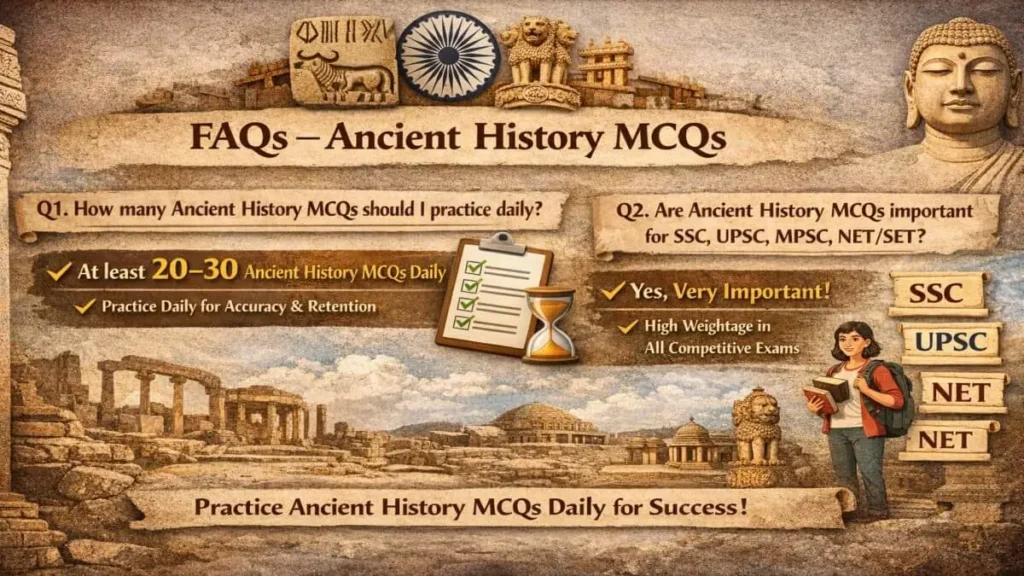
FAQs – Ancient History MCQs
Q1. How many Ancient History MCQs should I practice daily for competitive exams?
👉 Answer: You should practice at least 20–30 Ancient History MCQs daily.
👉 Explanation: Regular practice improves accuracy and helps in better retention of facts, timelines, and concepts. Gradually, you can increase the number based on your preparation level.
Q2. Are Ancient History MCQs important for exams like SSC, UPSC, MPSC, and NET/SET?
👉 Answer: Yes, Ancient History MCQs are very important for all major competitive exams.
👉 Explanation: Questions from topics like Indus Valley Civilization, Vedic Period, Buddhism, Jainism, Mauryan and Gupta Empire are frequently asked, making this section highly scoring.