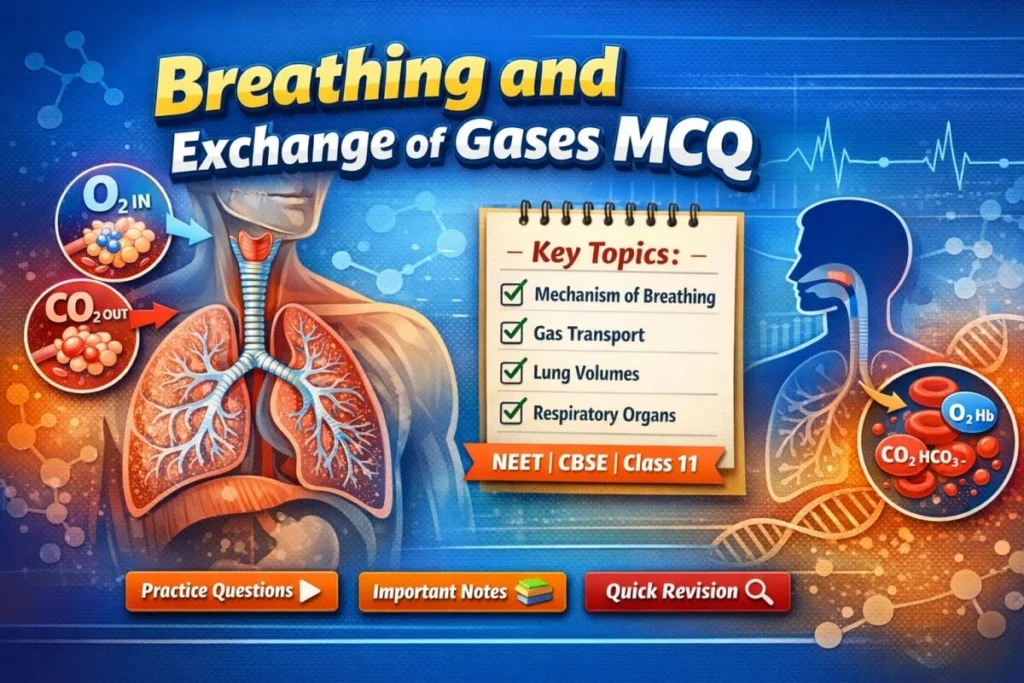
Practice 60+ Breathing and Exchange of Gases MCQ with answers, NEET & Class 11 questions, quiz, test & PDF for quick revision.
Breathing and Exchange of Gases MCQ (Overview)
Breathing and exchange of gases is a very important chapter in Class 11 Biology, which is based on the human respiratory system, oxygen transport and carbon dioxide removal. In this chapter, it is very important to understand core concepts like structure of lungs, breathing mechanism, gas exchange in alveoli and role of hemoglobin.
Why is MCQ practice important? Because questions are asked frequently on this topic in NEET and CBSE exams. Solving MCQs increases your concept clarity, improves your ability to handle tricky questions and also improves time management in the exam.
If you practice Breathing and Exchange of Gases MCQ regularly, it helps you revise important concepts and identify weak areas quickly. This increases your confidence in the exam and significantly improves your scoring potential.
👉 This is the official NCERT chapter covering breathing, gas exchange, and respiratory system in detail.
NEET तयारीसाठी MCQ practice खूप महत्वाची आहे. तुम्ही आमचा Biology MCQ For NEET हा full practice quiz नक्की solve करा.
Breathing and Exchange of Gases MCQ for NEET
This chapter is highly scoring for NEET, but the questions are a bit tricky and concept-based. The 20 MCQs given below have been prepared keeping in mind the NEET level difficulty – it contains assertion-reason, conceptual and application-based questions.
- During inspiration, which of the following happens?
A) Diaphragm relaxes
B) Thoracic volume decreases
C) Intrapulmonary pressure decreases
D) Lungs contract
✅ Answer: C
👉 Explanation: During inspiration, the diaphragm contracts and the thoracic cavity expands, which reduces the pressure and air enters the lungs.
- Assertion (A): Oxygen binds to hemoglobin forming oxyhemoglobin.
Reason (R): Hemoglobin has high affinity for oxygen in alveoli.
A) Both A and R true, R explains A
B) Both true, R not correct explanation
C) A true, R false
D) Both false
✅ Answer: A
👉 Explanation: Due to high oxygen concentration in alveoli, hemoglobin easily binds with oxygen.
- Maximum oxygen is transported in blood as:
A) Dissolved in plasma
B) Oxyhemoglobin
C) Carbaminohemoglobin
D) Bicarbonate
✅ Answer: B
👉 Explanation: ~97% oxygen binds with hemoglobin and is transported.
- Which factor shifts oxygen dissociation curve to right?
A) Low CO₂
B) Low temperature
C) High pH
D) High CO₂
✅ Answer: D
👉 Explanation: High CO₂ increases oxygen release due to Bohr effect.
- The respiratory center is located in:
A) Cerebrum
B) Medulla oblongata
C) Cerebellum
D) Hypothalamus
✅ Answer: B
👉 Explanation: Breathing control is in the medulla.
- Which volume remains in lungs after forceful expiration?
A) Tidal volume
B) Residual volume
C) Inspiratory reserve volume
D) Expiratory reserve volume
✅ Answer: B
👉 Explanation: Residual volume protects lungs from collapse.
- Assertion (A): CO₂ transport mainly occurs as bicarbonate.
Reason (R): Carbonic anhydrase catalyzes conversion of CO₂.
A) Both true, R explains A
B) Both true, not explanation
C) A true, R false
D) Both false
✅ Answer: A
👉 Explanation: In RBC enzyme carbonic anhydrase converts CO₂ → bicarbonate.
- Alveoli are suited for gas exchange because:
A) Thick walls
B) Low surface area
C) Rich blood supply
D) No capillaries
✅ Answer: C
👉 Explanation: Large surface area + rich capillaries = efficient diffusion.
- Bohr effect refers to:
A) Increased O₂ binding
B) Increased CO₂ binding
C) Decreased O₂ affinity at high CO₂
D) No change
✅ Answer: C
👉 Explanation: High CO₂ → hemoglobin releases O₂.
- Normal tidal volume in humans is about:
A) 100 ml
B) 500 ml
C) 1000 ml
D) 2000 ml
✅ Answer: B
👉 Explanation: In normal breathing there is ~500 ml air exchange.
- Chloride shift occurs in:
A) Plasma
B) RBCs
C) Lungs
D) Alveoli
✅ Answer: B
👉 Explanation: Chloride ions move during bicarbonate exchange in RBC.
- Assertion (A): Hemoglobin shows cooperative binding.
Reason (R): Binding of one O₂ increases affinity for next.
A) Both true, R explains A
B) Both true, not explanation
C) A true, R false
D) Both false
✅ Answer: A
👉 Explanation: Oxygen loading becomes efficient due to cooperative binding.
- Which is NOT a respiratory disorder?
A) Asthma
B) Emphysema
C) Pneumonia
D) Diabetes
✅ Answer: D
👉 Explanation: Diabetes is a metabolic disorder, not a respiratory one.
- Exchange of gases occurs by:
A) Active transport
B) Diffusion
C) Osmosis
D) Filtration
✅ Answer: B
👉 Explanation: Gas exchange takes place by diffusion based on concentration gradient.
- Which part prevents food entry into trachea?
A) Glottis
B) Epiglottis
C) Larynx
D) Pharynx
✅ Answer: B
👉 Explanation: Epiglottis stops food from entering the trachea.
- Which gas is transported mainly as bicarbonate?
A) Oxygen
B) Nitrogen
C) Carbon dioxide
D) Hydrogen
✅ Answer: C
👉 Explanation: ~70% CO₂ is transported in bicarbonate form.
- Assertion (A): Lung compliance decreases in fibrosis.
Reason (R): Lung tissue becomes stiff.
A) Both true, R explains A
B) Both true, not explanation
C) A true, R false
D) Both false
✅ Answer: A
👉 Explanation: Lungs become stiff due to fibrosis → compliance decreases.
- Partial pressure of oxygen in alveoli is approximately:
A) 40 mmHg
B) 104 mmHg
C) 70 mmHg
D) 20 mmHg
✅ Answer: B
👉 Explanation: Alveolar PO₂ is ~104 mmHg.
- Which pigment is responsible for oxygen transport?
A) Myoglobin
B) Hemoglobin
C) Chlorophyll
D) Melanin
✅ Answer: B
👉 Explanation: Hemoglobin carries oxygen in RBC.
- Vital capacity includes:
A) TV + IRV + ERV
B) TV only
C) RV only
D) IRV only
✅ Answer: A
👉 Explanation: Vital capacity = maximum air expelled after maximum inhalation.
Pro Tip (NEET)
👉 NEET has more concept-based MCQs + assertion-reason than direct theory
👉 Gas transport, Bohr effect, lung volumes are high-weightage topics
Breathing and Exchange of Gases MCQ for Class 11 (CBSE)
This section is based on CBSE syllabus (NCERT-based). Questions are basic + conceptual, which are very useful for school exams and foundation NEET prep.
- Breathing is defined as:
A) Exchange of gases in tissues
B) Intake of O₂ and release of CO₂
C) Transport of gases
D) Cellular respiration
✅ Answer: B
👉 Explanation: Breathing is the process of taking in oxygen and releasing carbon dioxide through the lungs.
- Which organ is responsible for breathing in humans?
A) Heart
B) Lungs
C) Kidney
D) Liver
✅ Answer: B
👉 Explanation: Lungs are the main organ for gas exchange.
- The nasal cavity helps in:
A) Digestion
B) Filtration of air
C) Blood circulation
D) Excretion
✅ Answer: B
👉 Explanation: Nasal cavity makes air clean, warm and moist.
- The smallest functional unit of lungs is:
A) Bronchus
B) Bronchiole
C) Alveolus
D) Trachea
✅ Answer: C
👉 Explanation: Gas exchange takes place in Alveoli.
- How many lungs are present in humans?
A) One
B) Two
C) Three
D) Four
✅ Answer: B
👉 Explanation: Humans have two lungs.
- The process of taking air into lungs is called:
A) Expiration
B) Inspiration
C) Diffusion
D) Respiration
✅ Answer: B
👉 Explanation: Taking in air is called inspiration.
- During expiration, diaphragm:
A) Contracts
B) Relaxes
C) Expands
D) Stiffens
✅ Answer: B
👉 Explanation: Diaphragm relaxes during expiration.
- Oxygen is transported by:
A) Plasma
B) Hemoglobin
C) Platelets
D) WBC
✅ Answer: B
👉 Explanation: Hemoglobin binds oxygen and transports it.
- Carbon dioxide is mainly transported as:
A) Oxyhemoglobin
B) Carbaminohemoglobin
C) Bicarbonate
D) Free gas
✅ Answer: C
👉 Explanation: CO₂ goes mostly into bicarbonate form.
- Which structure connects pharynx to trachea?
A) Larynx
B) Bronchus
C) Lung
D) Alveoli
✅ Answer: A
👉 Explanation: Larynx connects pharynx and trachea.
- The trachea is also known as:
A) Windpipe
B) Food pipe
C) Blood vessels
D) Air sac
✅ Answer: A
👉 Explanation: Trachea is called windpipe.
- Exchange of gases in alveoli occurs by:
A) Active transport
B) Diffusion
C) Osmosis
D) Filtration
✅ Answer: B
👉 Explanation: Diffusion occurs due to concentration gradient.
- The number of alveoli in human lungs is approximately:
A) 30 million
B) 300 million
C) 3 million
D) 30 thousand
✅ Answer: B
👉 Explanation: ~300 million alveoli increase the surface area.
- Which gas is required for cellular respiration?
A) CO₂
B) O₂
C) N₂
D) H₂
✅ Answer: B
👉 Explanation: Oxygen is essential for energy production.
- The exchange of gases in tissues is called:
A) External respiration
B) Internal respiration
C) Breathing
D) Ventilation
✅ Answer: B
👉 Explanation: Gas exchange in tissues = internal respiration.
- Which of the following is NOT a respiratory organ?
A) Trachea
B) Bronchi
C) Kidney
D) Lungs
✅ Answer: C
👉 Explanation: Kidney is an excretory organ.
- The opening of trachea is guarded by:
A) Glottis
B) Epiglottis
C) Pharynx
D) Larynx
✅ Answer: B
👉 Explanation: Epiglottis prevents food entry.
- Normal breathing rate in adults is:
A) 5–10/min
B) 12–16/min
C) 20–25/min
D) 30–35/min
✅ Answer: B
👉 Explanation: Normal resting rate is 12-16 breaths/min.
- Which part of respiratory system moistens air?
A) Trachea
B) Nasal cavity
C) Lungs
D) Bronchi
✅ Answer: B
👉 Explanation: Humidifies nasal cavity air.
- The primary function of lungs is:
A) Pump blood
B) Digestive food
C) Exchange gases
D) Remove waste
✅ Answer: C
👉 Explanation: Lungs exchange oxygen and carbon dioxide.
Quick Tip (CBSE)
👉 Read NCERT line-by-line – direct MCQs come
👉 Diagrams (alveoli, lungs) are very important
👉 Keep Definitions + basic concepts clear
Breathing and Exchange of Gases MCQ Questions with Answers
This is the main section where you are given Easy → Moderate → Hard level MCQs. These questions are useful for both NEET and CBSE.
Easy Level MCQs
- The process of breathing is also called:
A) Respiration
B) Ventilation
C) Digestion
D) Circulation
✅ Answer: B
👉 Explanation: Breathing is called ventilation.
- Which gas is inhaled during breathing?
A) CO₂
B) O₂
C) N₂
D) H₂
✅ Answer: B
👉 Explanation: Oxygen is inhaled.
- Lungs are located in:
A) Abdomen
B) Thoracic cavity
C) Cranial cavity
D) Pelvic cavity
✅ Answer: B
👉 Explanation: Lungs are located in the chest (thoracic cavity).
- The windpipe is known as:
A) Bronchus
B) Trachea
C) Larynx
D) Pharynx
✅ Answer: B
👉 Explanation: Trachea is called windpipe.
- Gas exchange occurs in:
A) Bronchi
B) Trachea
C) Alveoli
D) Larynx
✅ Answer: C
👉 Explanation: Exchange takes place in Alveoli.
- Oxygen is carried by:
A) RBCs
B) WBC
C) Platelets
D) Plasma
✅ Answer: A
👉 Explanation: Hemoglobin in RBC carries oxygen.
- Which organ helps in breathing movement?
A) Heart
B) Diaphragm
C) Kidney
D) Liver
✅ Answer: B
👉 Explanation: Diaphragm is essential for breathing.
Moderate Level MCQs
- During inspiration, ribs move:
A) Downward
B) Upward
C) Inward
D) No movement
✅ Answer: B
👉 Explanation: Ribs move upwards and outwards.
- Which gas is mainly transported as bicarbonate?
A) O₂
B) CO₂
C) N₂
D) H₂
✅ Answer: B
👉 Explanation: CO₂ goes into bicarbonate form.
- Tidal volume refers to:
A) Max air inhaled
B) Air during normal breathing
C) Air after forced exhalation
D) Residual air
✅ Answer: B
👉 Explanation: Air coming in normal breath.
- Which enzyme helps in CO₂ transport?
A) Amylase
B) Pepsin
C) Carbonic anhydrase
D) Lipase
✅ Answer: C
👉 Explanation: CO₂ → bicarbonate conversion.
- The exchange of gases between blood and tissues is:
A) External respiration
B) Internal respiration
C) Breathing
D) Ventilation
✅ Answer: B
👉 Explanation: Tissue level gas exchange.
- Hemoglobin is present in:
A) Plasma
B) RBCs
C) WBC
D) Platelets
✅ Answer: B
👉 Explanation: RBC contains hemoglobin.
- Residual volume helps in:
A) Digestion
B) Prevent lung collapse
C) Blood flow
D) Oxygen binding
✅ Answer: B
👉 Explanation: RV does not allow lungs to collapse.
Hard Level MCQs
- Oxygen dissociation curve shifts right due to:
A) Low CO₂
B) Low temperature
C) High CO₂
D) High pH
✅ Answer: C
👉 Explanation: O₂ release increases due to Bohr effect.
- Which factor decreases hemoglobin affinity for oxygen?
A) Low CO₂
B) High pH
C) High temperature
D) Low temperature
✅ Answer: C
👉 Explanation: High temp → O₂ release increase.
- Maximum CO₂ is transported as:
A) Carbaminohemoglobin
B) Dissolved gas
C) Bicarbonate
D) Oxyhemoglobin
✅ Answer: C
👉 Explanation: ~70% bicarbonate form.
- The partial pressure of oxygen in alveoli is:
A) 40 mmHg
B) 104 mmHg
C) 70 mmHg
D) 20 mmHg
✅ Answer: B
👉 Explanation: Standard alveolar PO₂.
- Chloride shift occurs during:
A) O₂ transport
B) CO₂ transport
C) Digestion
D) Filtration
✅ Answer: B
👉 Explanation: Ion exchange in RBC.
- Vital capacity is:
A) TV + IRV + ERV
B) TV only
C) RV only
D) IRV only
✅ Answer: A
👉 Explanation: Maximum air expelled after inhalation.
Final Tip
👉 By practicing Easy → Moderate → Hard, concepts become strong
👉 Conceptual clarity + repeated revision = success for NEET
Breathing and Exchange of Gases MCQ Test (Practice Set)
This time-based practice test is designed for NEET and CBSE preparation.
- During inspiration, diaphragm:
A) Relaxes
B) Contracts
C) Expands
D) Stops
✅ Answer: B
👉 Explanation: Diaphragm contracts and thoracic cavity expands.
- Exchange of gases occurs in:
A) Trachea
B) Bronchi
C) Alveoli
D) Larynx
✅ Answer: C
👉 Explanation: Gas exchange takes place in Alveoli by diffusion.
- Oxygen is transported by:
A) Plasma
B) Hemoglobin
C) Platelets
D) WBC
✅ Answer: B
👉 Explanation: Hemoglobin binds O₂.
- CO₂ is mainly transported as:
A) Dissolved gas
B) Carbaminohemoglobin
C) Bicarbonate
D) Oxyhemoglobin
✅ Answer: C
👉 Explanation: ~70% CO₂ in bicarbonate form.
- Normal breathing is called:
A) Respiration
B) Ventilation
C) Circulation
D) Diffusion
✅ Answer: B
👉 Explanation: Breathing = ventilation.
- Tidal volume is:
A) Max inhaled air
B) Normal breathing air
C) Residual air
D) Forced air
✅ Answer: B
- The windpipe is:
A) Larynx
B) Bronchus
C) Trachea
D) Alveoli
✅ Answer: C
- Bohr effect is related to:
A) O₂ transport
B) CO₂ effect on O₂ release
C) Digestion
D) Blood pressure
✅ Answer: B
- Residual volume helps in:
A) Digestion
B) Prevent collapse
C) Oxygen binding
D) Filtration
✅ Answer: B
- Alveoli provide:
A) Low surface area
B) High surface area
C) No exchange
D) Storage
✅ Answer: B
- Hemoglobin is found in:
A) Plasma
B) RBCs
C) WBC
D) Platelets
✅ Answer: B
- CO₂ transport enzyme is:
A) Amylase
B) Lipase
C) Carbonic anhydrase
D) Pepsin
✅ Answer: C
- Inspiration occurs when pressure is:
A) High
B) Low
C) Equal
D) Zero
✅ Answer: B
- Oxygen dissociation curve shifts right due to:
A) Low CO₂
B) High CO₂
C) Low temp
D) High pH
✅ Answer: B
- Number of alveoli:
A) 3 million
B) 30 million
C) 300 million
D) 3000
✅ Answer: C
- Internal respiration occurs in:
A) Lungs
B) Blood
C) Tissues
D) Nose
✅ Answer: C
- Which prevents food entry in trachea?
A) Larynx
B) Epiglottis
C) Pharynx
D) Bronchi
✅ Answer: B
- Partial pressure of O₂ in alveoli:
A) 40 mmHg
B) 104 mmHg
C) 70 mmHg
D) 20 mmHg
✅ Answer: B
- Vital capacity includes:
A) TV
B) RV
C) TV + IRV + ERV
D) IRV
✅ Answer: C
- Diffusion depends on:
A) Pressure gradient
B) Temperature
C) Surface area
D) All of these
✅ Answer: D
👉 Explanation: Diffusion efficiency depends on gradient + area + temperature.
Breathing and Exchange of Gases MCQ Quiz (Interactive Practice)
This quick revision quiz is perfect for NEET and CBSE students.
👉 Each question is accompanied by a 1-line explanation for fast revision.
- Breathing involves:
A) Only O₂ intake
B) Only CO₂ release
C) O₂ intake and CO₂ release
D) Blood circulation
✅ Answer: C
👉 Explanation: Breathing = Taking in O₂ + Exhaling CO₂
- Gas exchange occurs in:
A) Trachea
B) Bronchi
C) Alveoli
D) Larynx
✅ Answer: C
👉 Explanation: Exchange takes place in Alveoli by diffusion
- Oxygen is mainly transported by:
A) Plasma
B) Hemoglobin
C) WBC
D) Platelets
✅ Answer: B
👉 Explanation: Hemoglobin binds O₂
- CO₂ is mainly transported as:
A) Gas
B) Carbamino
C) Bicarbonate
D) Oxygen
✅ Answer: C
👉 Explanation: CO₂ goes into bicarbonate form
- Tidal volume is:
A) Forced air
B) Normal breathing air
C) Residual air
D) Maximum air
✅ Answer: B
👉 Explanation: Normal breath = tidal volume
- Diaphragm during inspiration:
A) Relaxes
B) Contracts
C) Stops
D) Expands
✅ Answer: B
👉 Explanation: Lungs expand by contracting
- Windpipe is called:
A) Bronchi
B) Trachea
C) Larynx
D) Pharynx
✅ Answer: B
👉 Explanation: Trachea = windpipe
- Number of alveoli:
A) 3 million
B) 30 million
C) 300 million
D) 3000
✅ Answer: C
👉 Explanation: ~300 million for large surface area
- Oxygen dissociation curve shifts right due to:
A) Low CO₂
B) High CO₂
C) Low temp
D) High pH
✅ Answer: B
👉 Explanation: O₂ release increases due to Bohr effect
- Hemoglobin is present in:
A) Plasma
B) RBCs
C) WBC
D) Platelets
✅ Answer: B
👉 Explanation: RBC contains hemoglobin
- Residual volume prevents:
A) Digestion
B) Lung collapse
C) Circulation
D) Filtration
✅ Answer: B
👉 Explanation: RV does not allow lungs to collapse
- CO₂ transport enzyme:
A) Amylase
B) Lipase
C) Carbonic anhydrase
D) Pepsin
✅ Answer: C
👉 Explanation: CO₂ → bicarbonate conversion
- Internal respiration occurs in:
A) Lungs
B) Blood
C) Tissues
D) Nose
✅ Answer: C
👉 Explanation: Tissue level exchange
- Epiglottis function:
A) Breathing
B) Digestion
C) Prevent food entry
D) Blood flow
✅ Answer: C
👉 Explanation: Stops the passage of food into the trachea
- Partial pressure of O₂ in Alveoli:
A) 40 mmHg
B) 104 mmHg
C) 70 mmHg
D) 20 mmHg
✅ Answer: B
👉 Explanation: Standard alveolar PO₂ ~104 mmHg
- Vital capacity includes:
A) TV
B) RV
C) TV + IRV + ERV
D) IRV
✅ Answer: C
👉 Explanation: Maximum expelled air
- Diffusion depends on:
A) Gradient
B) Surface area
C) Temperature
D) All
✅ Answer: D
👉 Explanation: All factors are important
- Breathing rate in adults:
A) 5–10
B) 12–16
C) 20–25
D) 30–40
✅ Answer: B
👉 Explanation: Normal rate 12–16/min
- Oxygen binding pigment:
A) Myoglobin
B) Hemoglobin
C) Chlorophyll
d) Melanin
✅ Answer: B
👉 Explanation: Hemoglobin carries O₂
- External respiration occurs in:
A) Tissues
B) Blood
C) Lungs
D) Heart
✅ Answer: C
👉 Explanation: Gas exchange in Lungs
Quick Tip
👉 Solve this quiz daily = fast revision
👉 1-line explanation = memory retention increases
👉 Mark weak questions and revise
Breathing and Exchange of Gases MCQ for Self Study
This section is specially designed for students who are doing self-study. Smart study + fast MCQ solving techniques are very important for NEET and CBSE preparation.
Study Tips + MCQ Solving Techniques
1. Study NCERT Line-by-Line
👉 Questions come directly from NCERT in Biology, so understand each line.
2. Keep Concepts Clear (No Rattta)
👉 Understand breathing mechanism, gas exchange – logic based questions come.
3. Practice Diagrams
👉 Revise Lungs, alveoli, respiratory system diagrams – visual memory becomes strong.
4. Solve Easy → Hard MCQs
👉 Solve basic questions first, then NEET level tricky MCQs.
5. Do Time-Based Practice
👉 Solve MCQs with timer = exam speed improves.
6. Keep a Wrong Questions Notebook
👉 Note down the questions in which you have made mistakes and revise them.
7. Practice Assertion-Reason
👉 They come frequently in NEET, so check the logic.
8. Use Elimination Technique
👉 By eliminating wrong options, you can easily get the correct answer.
9. Identify Keywords
👉 Remember the words “NOT”, “Correct”, “Incorrect” in the question.
10.Do Regular Revision
👉 Revising 2–3 times increases retention.
Important Topics for MCQ
1. Mechanism of Breathing
👉 Inspiration vs Expiration differences
2. Lung Volumes and Capacities
👉 Tidal Volume, Vital Capacity, Residual Volume
3. Exchange of Gases
👉 Diffusion process in Alveoli
4. Transport of Oxygen
👉 Hemoglobin + Oxyhemoglobin formation
5. Transport of Carbon Dioxide
👉 Bicarbonate formation + chloride shift
6. Oxygen Dissociation Curve
👉 Left vs Right shift (Bohr effect)
7. Respiratory Disorders
👉 Asthma, Emphysema, Pneumonia basics
8. Role of Hemoglobin
👉 Oxygen binding capacity + affinity
9. Partial Pressure Concepts
👉 O₂ and CO₂ gradients
10. NCERT Examples + Diagrams
👉 High probability of getting direct exam questions
Pro Strategy (Self Study)
👉 Solve 20-30 MCQs daily
👉 Concept + Practice = Best combo
👉 Revise weak topics → Make yourself strong
👉 Mock test + analysis = topper strategy
Final Tip
👉 You can’t get a high score without smart study
👉 Consistency = Success in NEET & CBSE
Key Topics to Cover in Breathing and Exchange of Gases
To gain a strong grip in this chapter, it is very important to understand the following core topics. These topics are frequently asked in both NEET and CBSE.
1. Mechanism of Breathing
- 👉 How does Inspiration and Expiration process happen?
- 👉 Diaphragm and ribs movement
- 👉 Pressure changes (intrapulmonary pressure)
2. Gas Transport
- 👉 Oxygen transport (hemoglobin binding)
- 👉 Carbon dioxide transport (bicarbonate, carbamino form)
- 👉 Chloride shift concept
3. Lung Volumes and Capacities
- 👉 Tidal Volume (TV)
- 👉 Inspiratory Reserve Volume (IRV)
- 👉 Expiratory Reserve Volume (ERV)
- 👉 Vital Capacity (VC)
- 👉 Residual Volume (RV)
4. Respiratory Organs
- 👉 Nose → Pharynx → Larynx → Trachea → Bronchi → Lungs
- 👉 Alveoli structure and function
- 👉 Gas exchange surface area
5. Exchange of Gases
- 👉 Diffusion mechanism
- 👉 Partial pressure gradients (O₂ and CO₂)
- 👉 Exchange between alveoli and tissues
6. Oxygen Dissociation Curve
- 👉 Left shift vs Right shift
- 👉 Bohr effect
- 👉 Temperature, pH, CO₂ effect
FAQs – Breathing and Exchange of Gases MCQ
Q1. What are the most important MCQs?
👉 MCQs on Lung volumes, gas transport, Bohr effect, alveoli structure are asked the most.
Q2. What is the weightage of this chapter in NEET?
👉 There are usually 2–3 questions, but since it is concept-based, the scoring opportunity is more.
Q3. Where to download Breathing and Exchange of Gases MCQ PDF?
👉 You can download free PDF from study blogs, educational websites or notes platforms (you can give it as a lead magnet on your blog 😉).
Q4. How to increase speed while solving MCQs?
👉 Use regular practice + time-based tests + elimination technique.
Q5. How important is NCERT?
👉 90% questions are based on NCERT concepts – study line-by-line.
Final Revision Tips for Breathing and Exchange of Gases
Last-Minute Exam Tips
- Keep revision notes short and precise
- Revise diagrams (alveoli, lungs) once
- Memorize important formulas/values (PO₂, volumes)
- Solve 1–2 mock tests before the exam
Avoid Common Mistakes
- Don’t confuse Breathing vs Respiration
- Don’t mix lung volumes (TV, VC, RV)
- Don’t memorize CO₂ transport forms incorrectly
- Don’t rush into assertion-reason questions
Final Takeaway
- Concept clarity + MCQ practice = high score
- Smart revision + consistency = success