
Force and Laws of Motion is an important chapter in Class 9 Science. It explains the concepts of force, inertia, momentum, Newton’s three laws of motion, and conservation of momentum.
Practising multiple-choice questions (MCQs) is an effective way for students to prepare for school examinations, tests, and competitive exams.
In this article, you will find 30 important MCQs on Force and Laws of Motion for Class 9 Science, along with correct answers and explanations.
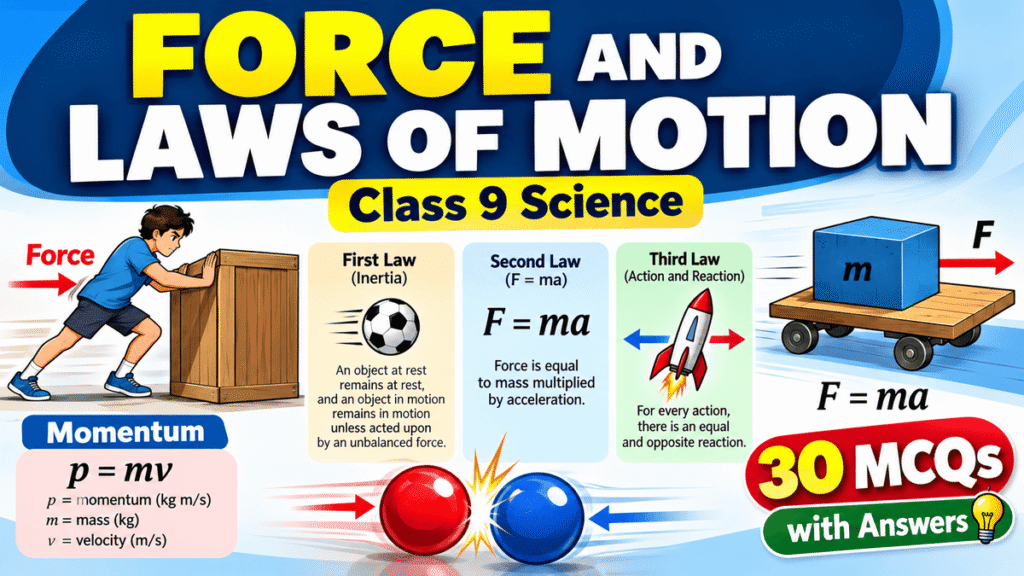
MCQs on Force and Laws of Motion – Class 9
1. What is force?
A) A form of energy
B) A push or pull acting on an object
C) A type of motion
D) A type of matter
Correct Answer: B) A push or pull acting on an object
Explanation: Force is a push or pull that can change the state of motion, direction, or shape of an object.
2. What is the SI unit of force?
A) Joule
B) Watt
C) Newton
D) Pascal
Correct Answer: C) Newton
Explanation: The SI unit of force is the newton (N).
3. Who formulated the three laws of motion?
A) Albert Einstein
B) Isaac Newton
C) Galileo Galilei
D) James Watt
Correct Answer: B) Isaac Newton
Explanation: Sir Isaac Newton formulated the three laws of motion.
4. Which law of motion is also known as the law of inertia?
A) First law
B) Second law
C) Third law
D) Law of gravitation
Correct Answer: A) First law
Explanation: Newton’s first law is called the law of inertia because it describes the tendency of an object to resist changes in its state of motion.
5. What is inertia?
A) Ability to change shape
B) Tendency to resist a change in its state of motion
C) Ability to produce energy
D) Ability to increase speed
Correct Answer: B) Tendency to resist a change in its state of motion
Explanation: Inertia is the property of an object by which it resists any change in its state of rest or uniform motion.
6. Which physical quantity measures the inertia of an object?
A) Speed
B) Velocity
C) Mass
D) Acceleration
Correct Answer: C) Mass
Explanation: Mass is a measure of the inertia of an object. Greater mass means greater inertia.
7. What is the SI unit of momentum?
A) kg m/s
B) kg m/s²
C) Newton
D) Joule
Correct Answer: A) kg m/s
Explanation: Momentum is the product of mass and velocity. Its SI unit is kg m/s.
8. What is the formula for momentum?
A) Mass × Acceleration
B) Mass × Velocity
C) Force × Distance
D) Mass ÷ Velocity
Correct Answer: B) Mass × Velocity
Explanation: Momentum is calculated using the formula p = mv.
9. Newton’s second law of motion gives the relationship between:
A) Force and acceleration
B) Mass and volume
C) Energy and power
D) Distance and time
Correct Answer: A) Force and acceleration
Explanation: Newton’s second law states that force is proportional to the rate of change of momentum.
10. What is the mathematical expression of Newton’s second law?
A) F = ma
B) F = mv
C) F = m/a
D) F = a/m
Correct Answer: A) F = ma
Explanation: For constant mass, force is equal to mass multiplied by acceleration.
11. What happens when an unbalanced force acts on an object?
A) It always remains at rest
B) Its state of motion may change
C) Its mass becomes zero
D) Its weight disappears
Correct Answer: B) Its state of motion may change
Explanation: An unbalanced force can change the speed or direction of an object.
12. Which law states that every action has an equal and opposite reaction?
A) Newton’s first law
B) Newton’s second law
C) Newton’s third law
D) Law of inertia
Correct Answer: C) Newton’s third law
Explanation: Newton’s third law states that every action has an equal and opposite reaction.
13. When a gun is fired, it moves backwards due to:
A) Friction
B) Inertia
C) Recoil
D) Gravity
Correct Answer: C) Recoil
Explanation: A gun recoils backwards because the bullet moves forward and an equal and opposite reaction acts on the gun.
14. Why does a passenger fall forward when a moving bus suddenly stops?
A) Due to gravity
B) Due to inertia of motion
C) Due to friction
D) Due to acceleration
Correct Answer: B) Due to inertia of motion
Explanation: The lower part of the body stops with the bus, while the upper part tends to continue moving forward.
15. Which of the following has the greatest inertia?
A) A tennis ball
B) A football
C) A bicycle
D) A truck
Correct Answer: D) A truck
Explanation: Inertia depends on mass. A truck has the greatest mass among these objects.
16. What is the momentum of an object at rest?
A) Maximum
B) Minimum but not zero
C) Zero
D) Infinite
Correct Answer: C) Zero
Explanation: An object at rest has zero velocity, so its momentum is zero.
17. What is the acceleration of an object when the net force acting on it is zero?
A) Zero
B) One
C) Infinite
D) Negative
Correct Answer: A) Zero
Explanation: According to Newton’s second law, zero net force produces zero acceleration.
18. A force of 10 N acts on a body of mass 2 kg. What is its acceleration?
A) 2 m/s²
B) 5 m/s²
C) 10 m/s²
D) 20 m/s²
Correct Answer: B) 5 m/s²
Explanation: Using F = ma, a = F/m = 10/2 = 5 m/s².
19. What happens to momentum if the velocity of an object doubles while its mass remains constant?
A) Momentum becomes half
B) Momentum becomes double
C) Momentum remains unchanged
D) Momentum becomes zero
Correct Answer: B) Momentum becomes double
Explanation: Momentum is directly proportional to velocity when mass is constant.
20. Which of the following is an example of Newton’s third law?
A) A book resting on a table
B) A person walking on the ground
C) A stone falling freely
D) A car slowing down
Correct Answer: B) A person walking on the ground
Explanation: While walking, a person pushes the ground backwards, and the ground pushes the person forwards.
21. What is the rate of change of momentum called?
A) Energy
B) Power
C) Force
D) Work
Correct Answer: C) Force
Explanation: Newton’s second law defines force as the rate of change of momentum.
22. What is the law of conservation of momentum?
A) Momentum is always zero
B) Total momentum remains constant in an isolated system
C) Momentum always increases
D) Momentum depends only on mass
Correct Answer: B) Total momentum remains constant in an isolated system
Explanation: In the absence of external forces, the total momentum of a system remains conserved.
23. Which quantity is a vector quantity?
A) Mass
B) Speed
C) Momentum
D) Distance
Correct Answer: C) Momentum
Explanation: Momentum has both magnitude and direction, so it is a vector quantity.
24. A body of mass 5 kg moves with a velocity of 4 m/s. Calculate its momentum.
A) 10 kg m/s
B) 15 kg m/s
C) 20 kg m/s
D) 25 kg m/s
Correct Answer: C) 20 kg m/s
Explanation: Momentum = Mass × Velocity = 5 × 4 = 20 kg m/s.
25. Why are seat belts used in cars?
A) To increase speed
B) To reduce the effect of inertia during sudden stops
C) To increase acceleration
D) To reduce the mass of passengers
Correct Answer: B) To reduce the effect of inertia during sudden stops
Explanation: Seat belts help prevent passengers from moving forward due to inertia when a vehicle stops suddenly.
26. Which of the following has more momentum?
A) A 2 kg body moving at 3 m/s
B) A 3 kg body moving at 2 m/s
C) Both have equal momentum
D) Neither has momentum
Correct Answer: C) Both have equal momentum
Explanation: First body: 2 × 3 = 6 kg m/s. Second body: 3 × 2 = 6 kg m/s.
27. What is the SI unit of acceleration?
A) m/s
B) m/s²
C) kg m/s
D) Newton
Correct Answer: B) m/s²
Explanation: Acceleration is the rate of change of velocity with time.
28. Which type of force is required to change the direction of a moving object?
A) Balanced force
B) Unbalanced force
C) Zero force
D) No force
Correct Answer: B) Unbalanced force
Explanation: An unbalanced force can change the direction or speed of a moving object.
29. A cricket player moves his hands backwards while catching a fast-moving ball. Why?
A) To increase the force
B) To reduce the time of impact
C) To increase the time of impact and reduce the force
D) To increase the momentum of the ball
Correct Answer: C) To increase the time of impact and reduce the force
Explanation: Increasing the time taken to stop the ball reduces the average force experienced by the player’s hands.
30. Which of the following is an example of inertia of rest?
A) A passenger falls forward when a bus stops
B) Dust comes out when a carpet is beaten
C) A coin falls into a glass when the card beneath it is removed suddenly
D) A ball rolling down a slope
Correct Answer: C) A coin falls into a glass when the card beneath it is removed suddenly
Explanation: The coin tends to remain in its state of rest when the card is removed.
Answer Key – Force and Laws of Motion Class 9
| Question | Answer | Question | Answer |
|---|---|---|---|
| 1 | B | 16 | C |
| 2 | C | 17 | A |
| 3 | B | 18 | B |
| 4 | A | 19 | B |
| 5 | B | 20 | B |
| 6 | C | 21 | C |
| 7 | A | 22 | B |
| 8 | B | 23 | C |
| 9 | A | 24 | C |
| 10 | A | 25 | B |
| 11 | B | 26 | C |
| 12 | C | 27 | B |
| 13 | C | 28 | B |
| 14 | B | 29 | C |
| 15 | D | 30 | C |
Important Formulas – Force and Laws of Motion
| Physical Quantity | Formula |
|---|---|
| Force | F = ma |
| Momentum | p = mv |
| Acceleration | a = (v-u)/t |
| Force in terms of momentum | F = (mv-mu)/t |
| Conservation of momentum | m₁u₁ + m₂u₂ = m₁v₁ + m₂v₂ |
Where:
- F = Force
- m = Mass
- a = Acceleration
- p = Momentum
- u = Initial velocity
- v = Final velocity
- t = Time
Frequently Asked Questions (FAQs)
1. What are the three laws of motion?
Newton’s three laws of motion are:
First Law – Law of Inertia.
Second Law – Law of Acceleration.
Third Law – Law of Action and Reaction.
2. What is inertia in Class 9 Science?
Inertia is the tendency of an object to resist any change in its state of rest or uniform motion.
3. What is the SI unit of momentum?
The SI unit of momentum is kilogram metre per second (kg m/s).
4. What is Newton’s second law of motion?
Newton’s second law states that the rate of change of momentum of an object is directly proportional to the applied force and takes place in the direction of the force.
5. What is the formula for force?
The formula for force is F = ma, where F is force, m is mass, and a is acceleration.
6. Why is Newton’s first law called the law of inertia?
It is called the law of inertia because it explains the tendency of an object to resist changes in its state of rest or motion.
Conclusion
Force and Laws of Motion is an important chapter in Class 9 Science. Understanding Newton’s three laws, inertia, momentum, and conservation of momentum helps students develop a strong foundation in physics.
These 30 MCQs with answers and explanations will help students revise important concepts and prepare effectively for examinations. Practise these questions regularly to improve your understanding and confidence in Science.
